When marketing meets moral panic: an analysis of a critical success that blurs the lines.
Tailored like a marketing product, Netflix’s series Adolescence has achieved resounding media success, sparking a heated political debate about online masculinism — particularly in the UK. While the subject may be legitimate, it is tackled here through an unrealistic and fantasized scenario; in this sense, the series paradoxically contributes to the dangers of our time.
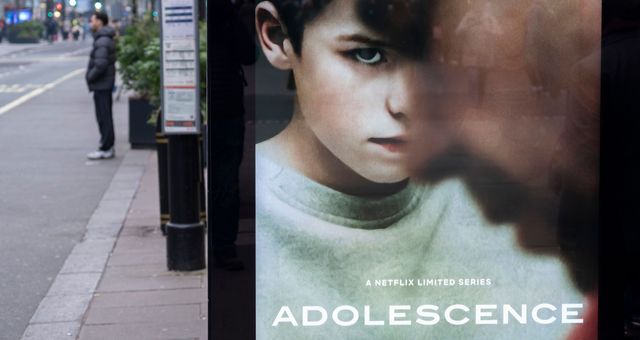
A curious paradox: just a few weeks ago, the media were raising alarms about the influence of Netflix’s Squid Game (1, among others) on violent playground games in primary schools. And yet now, it seems perfectly acceptable to let the very same streaming giant into the classroom — this time to promote Adolescence, a dramatic fiction in which a family’s life is turned upside down after their 13-year-old son is arrested for the murder of a classmate.
As a devoted fan of British series, I watched Adolescence. But by the time the episode was over, it had left me with a very strange feeling. Despite the strong acting performances, this show won’t make it into my personal top list. Everyone seems a little too enthusiastic. When critics from Télérama to Le Figaro are in complete agreement, something feels off. The media frenzy has generated a salutary buzz for the once-dominant on-demand series pioneer. With such massive press exposure, public curiosity inevitably drives up viewership and allows the series to establish itself as a social phenomenon — one that quickly draws in political attention. It feels like a marketing move executed to perfection. But that doesn’t make the underlying themes any less legitimate: Adolescence raises essential questions about masculinism, bullying, and the influence of social media on teenagers, which breeds… violence and insecurity.
This marketing coup couldn’t have come at a better time for Netflix, which in recent years has faced growing critical disappointment and increasingly fierce competition — whether from the veteran HBO (Max) or opportunistic newcomers like Amazon Prime and Apple TV+. Once the undisputed leader of streaming, Netflix now holds only 27% share of the French market in 2024. With Adolescence, the platform seeks to reclaim its image as a trendsetter — not only narratively, but also technically. Télérama is glowing in its praise of the series’ use of enormous single takes (each episode is filmed as a nearly one-hour-long continuous shot), while France Info goes into detail about the weeks of preparation required.
Magnificent as it may be, the long take is a technical device that demands exceptional skill, both in directing and in acting. The scenes are shot in one uninterrupted movement, with no visible cuts for the audience — at least in theory, since the camera can discreetly pause on a static moment, a trick made easier today by digital technology. Critics may have had a point that Adolescence is by no means at the forefront of this approach: in recent years, sequence shot have flourished, often in even bolder formats — Victoria by Sebastian Schipper (2015), shot in a single 2-hour-14-minute take; 1917 by Sam Mendes (2019), which admits to faking its two-hour one-shot format; and even a Russian film Russian Ark by Alexander Sokurov (2002). But the real question isn’t about technical prowess — or the cleverness of Adolescence’s press kit — but rather about the purpose behind this stylistic choice.
To say what, exactly? Traditionally, the long take is used to capture a raw sense of reality — uninterrupted, unedited — allowing for narrative breathing room, for silences, for stillness. But in Adolescence, such pauses are nowhere to be found. The direction follows the cardinal rule of today’s Net 2.0 video production: uninterrupted attention capture. The viewer must never be given the chance to look away.
This chase for audience attention is coupled with an unapologetically sensationalist approach. Not only are moments of pause eliminated, but constant action — whether physical or psychological — is required. The result is a caricatured portrayal of society, one that offers the illusion of reality.
Indeed, Adolescence paints a distorted version of society. All institutions appear overwhelmed, decaying, or simply obsolete. The school is noisy and chaotic — a foul-smelling mess where teachers arrive late and struggle to manage students’ reactions. The police only intervene after the crime — despite it being captured by surveillance cameras — and respond with brute force, appearing just as powerless as every other form of authority. The series also sketches the figure of a judicial psychologist who, under the guise of building a psychological profile, probes a child’s intimate life while steering the conversation directly toward the issue of masculinism.
“You go through so many different emotions — it’s like a rollercoaster.” “Why is it shot in one long take? Simply so the viewer is forced to face the truth. So they don’t feel like they’re watching a film.”
Comments from YouTube series reviewers
Truth… or something like it. A sense of confusion begins to take hold around this distorted reality. Though Adolescence is clearly a work of fiction, its stylistic choices give it the appearance of a documentary. As a result, reality and fantasy blur. (The word “fantasy” comes from the Greek phantasma, meaning “ghost” or “visual hallucination.”) The absence of pauses, combined with the show’s sensationalism, short-circuits critical thinking: the viewer is overwhelmed, trapped in a constant state of unease, as if ordinary life could collapse at any moment.
Because Adolescence is, above all, a portrayal of the banality of evil. The perpetrator of the murder looks like an innocent child, raised in a respectable middle-class Anglo-Saxon family. “The child, with his cherubic face and urine-soaked pants, is suspected of stabbing a classmate to death,” reports Le Monde. The first episode begins with the brutal intrusion of the police into the family’s peaceful home.
Every parent can feel concerned by this form of silent, insidious radicalization — one that social media might very well exert on their own child. A new kind of anxiety emerges: the fear of no longer being able to decipher teenage language, of losing all grip on their inner world.
We’re swept into a flood of obscure terms and concepts: the manosphere (the masculinist movement), “incels” (involuntary celibates whose social stigma becomes a form of identity), or the 80/20 rule (which claims that 80% of women are attracted to 20% of men, supposedly justifying manipulative tactics). These are the kinds of theories spread by figures like Andrew Tate, a controversial influencer recently arrested in Romania on charges of human trafficking. The series plunges us into a parallel society, one that’s unsettling and unfamiliar — and one that awakens a latent fear: the fear of being disconnected from the real world. Adolescence serves as a warning, but at the same time, it delivers a kind of moral injunction.
Beware the parents who forget their child. Episode 4 opens with a striking scene: a father discovers that the word “Nonge” has been spray-painted on his car — a reference to sexual offenders, briefly raising the suspicion of incest as a possible explanation, before quickly dismissing it. The real subject here is the fear of social disgrace, which hangs heavily over the characters, growing into a kind of generalized suspicion and culminating in an intrusion into the family’s private sphere — already violated during the police raid that extended even into the parents’ bedroom.
An explanation? There won’t be one. The series deliberately chooses to skip the trial altogether. The director’s use of narrative acceleration up to this point gives the impression of a plea deal rushed through in four hours — the culmination of a judicial process whose professionalism can reasonably be called into question. The investigation presented in the third episode isn’t led by a judge, but by a psychologist. Justice is effectively replaced by another institution, one that is supposed to correct the individual’s mores and Justice is effectively replaced by another institution, one that is supposed to correct the individual’s mores and readjust them into society. In reality, at this stage of the proceedings, a psychological evaluation serves only to determine whether the accused is aware of their actions and fit to stand trial. Instead, the show immerses us in a long digression, driven by the psychologist’s at times intrusive questions and the child’s violent outbursts. After about thirty minutes of conversation, the expert seems to have formed an opinion based on a few fragile connections, before returning to her official role and hastily wrapping up the assessment with three final questions.
“It’s all there”, succinctly summarised by researcher Stéphanie Lamy in Le Monde: “The ideology of incels is based on ‘lookism,’ the idea that certain boys or men are ‘genetically oppressed,’ meaning physically unattractive, and that society therefore owes them access to the bodies of ‘genetically superior’ women.” This is illustrated in the series when Jamie follows accounts of models on Instagram and describes himself as ugly. When he shows interest in a girl, he believes she owes him gratitude” and to deduce ‘When she doesn’t give it to him, he slaughters her’. We are faced with absolute evil, no excuse is possible.
The series ends with a scene that moved many viewers: the final moments in the child’s bedroom, where the father, overwhelmed, utters in a broken voice, “I should have done better.”
There are no tears for the victim, nor for the perpetrator. What the series invites us to mourn is parental failure. The narrative structure leaves no room for the idea of a second chance — not even for the parents. There is no possibility of reclaiming their role, of supporting their child in prison, or of helping him toward any kind of psychological recovery. Redemption, in this story, is not even on the table.
In such a context, it’s hardly surprising that every parent might instinctively feel concerned — if not compelled to engage. Unsurprisingly, then, a journalist — herself the mother of a teenage boy the same age — invites readers to take that step in an article published in Le Point on April 6, 2025.
“Vadim says nothing. His eyes stay glued to the screen.” (…) I can sense he’s tense (…) I watch him silently. He turns slightly toward me, maybe looking for a reaction. “It’s impossible to believe someone my age could do that — and yet, I know it’s a true story.” (…) Then he suddenly continues, as if needing to get something off his chest: “Me, I’ve never done anything serious. I’ve got friends who’ve stolen stuff, for example. I don’t think they always realize what they’re doing. That it could actually have consequences.” (…) Then this line, out of nowhere: “I mean, it’s not the same to kill people in GTA… and to kill a real person.” (…) When the psychologist enters the room to evaluate Jamie, Vadim is surprised: “Actually, he’s smart.” He searches for words. “I don’t know… People usually think kids who do that kind of thing are dumb. That they didn’t think it through. But him — you can tell he gets it. That’s what’s scary, I think.” I watch him, and I know he grasps the weight of what he’s seeing, putting words to it with the logic of a child. (…) It could be any school. So I ask him, “And at your school, is it like that? Are there still the popular kids, the scapegoats?” He shrugs. “I don’t know, maybe… but it’s not really like that at my school.” (…) He seems a little relieved, happy that his school doesn’t resemble what he’s just seen. “Even though I know my school’s super strict and it’s not the same everywhere — in England, it looks more violent.” (…) “Have you ever been bullied?” I ask. He thinks for a minute, then replies: “People gave me a hard time when I was younger. Remember when I had long hair? But that’s over.” I listen, and I understand that, for him, it’s in the past. It was a moment, not a wound. But I hear something else. I think to myself: that’s how it always starts — a comment, a nickname, something that makes the others laugh. It doesn’t take much. Just a few kids laughing. (…) I watch him and wonder what it does to him, hearing masculinity talked about like something you have to achieve. Beside me, he gets impatient: “Honestly, I think she goes too far on the masculinity thing. That’s not really the issue. Yeah, I have friends who lift a bit, but it’s rare. We’re all just growing, our bodies keep changing. I guess… it must be tough when you’re really small. People don’t listen to you the same way.” I look at him. He says it without judgment — just like it’s obvious. And I realize he’s already talking about invisible hierarchies, about what we become in the eyes of others. (…) He doesn’t understand how a boy who seemed normal, almost invisible, could change that much. And I see it too. Jamie could have been any 13-year-old boy. He has that quiet, ordinary face — the kind you pass by without really noticing. That’s exactly what’s so disturbing: normality tipping over into horror. (…) When the episode ends, he seems almost disappointed. “They didn’t even show the trial,” he says. “That’s a shame.”
‘It’s crazy to think that a boy my age could have done that”: we watched “Adolescence” with a teenager, Le point, 06/04/2025
With all this in mind, one has to wonder: how can so many progressive media outlets heap praise on this series, and why do left-leaning political figures want it shown in schools? Adolescence paints a bleak portrait of society, detailing all its failings, offering no optimistic path to resolution, and pushing the envelope by urging people to act without allowing them to detach from their emotions. Politicians, then, become the next logical step: they hold the keys to recognition, influence, and direct access to schoolchildren. And in recent years, they’ve developed the unfortunate habit of responding to shocking news events with rushed decisions, rarely allowing themselves the space for careful analysis — thereby contributing, often unwittingly, to public confusion. Questioned by a Labour MP in the House of Commons, the British Prime Minister, Keir Starmer delivered a slip that was as revealing as it was unfortunate: “At home, we watch the series Adolescence with our kids. I have a 16-year-old son and a 14-year-old daughter. It’s a very, very good documentary to watch… uh, I mean, drama…” A slip of the tongue that speaks volumes — and one that’s particularly damaging: by mistaking fiction for documentary, the head of government and father of two implicitly validates, without critical distance, a work whose very ambiguity may be its greatest danger.
Adolescence feeds into a familiar narrative: that of an increasingly violent society, the resurgence of evil, and the inability of our institutions to respond. Faced with such a bleak picture, our collective fears push us to promote the series — if not to reinforce our own confirmation bias, then at least in the hope of finding some kind of reassuring solution. But that solution is far from evident, especially when it emerges from emotionally charged reactions and a fantasized view of reality. After rightly describing Adolescence as “hard-hitting TV,” the centre-left newspaper The Guardian didn’t seem convinced by the quick follow-up suggestion to ban mobile phones for teenagers. In its Focus podcast, attempts to gather reactions from young Britons — who admitted they were impressed, but not directly concerned — left the journalist unsatisfied. Perhaps it’s simply because the elements staged in Adolescence didn’t fit in with the real-life experiences of teenagers, and so, on principle, there was no serious outcome.
Since then, the British government has decided to show the series in schools. In France, Élisabeth Borne has — for now — declined to follow the British example. The website Arrêt sur images, usually known for its critical lens on the media, surprisingly aligned itself with the emotional tone of the moment : “The truth is out there.” Instead of offering real analytical distance, it too surrenders to the show’s ambiguity — calling not for reasoned critique, but for belief in a mystical, unquestionable truth.
#OurTime
Leave a Reply