As war returns to Europe, it is interesting to revisit films that explore its psychological consequences. Birdy (1984), directed by Alan Parker, examines the trauma of war from a unique perspective: the deep friendship between two young men, Birdy and Al. This is far from the general critique of American military policy, the horror of total despair found in Johnny Got His Gun or Apocalypse Now. Here, it is an intimate story where the Vietnam War plays an almost anecdotal role. A film where a critique of masculinity also emerges.
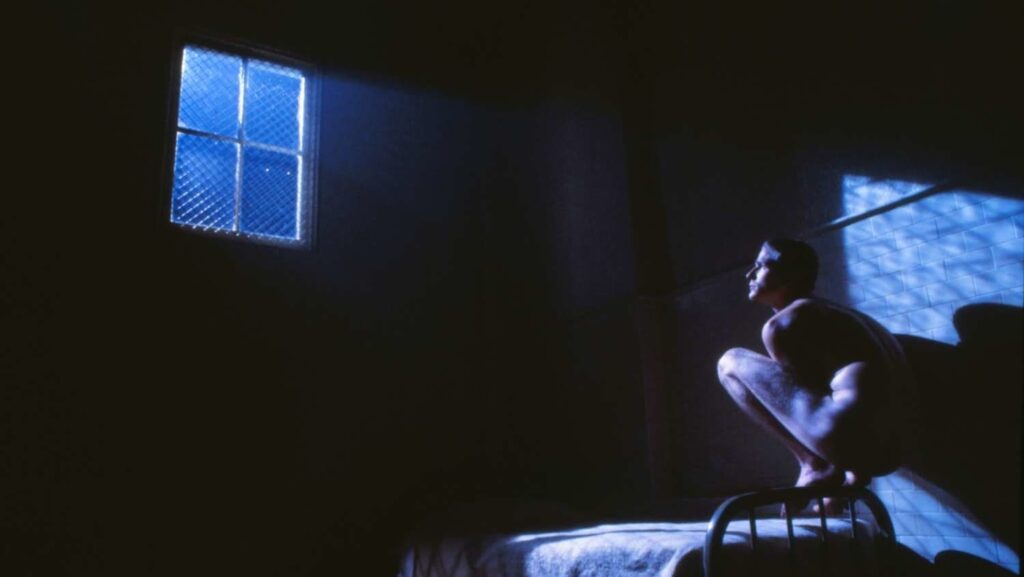
“We were very close friends, we weren’t queer or anything like that. We were just a couple of crazy kids from Philadelphia,” explains Al, a war survivor, severely wounded in the face with a steel jaw and a few pins in his brain, during his conversation with Dr. Weiss. Al has been called in to help his friend Birdy, who is being treated in a military psychiatric asylum. The entire film revolves around trying to prevent Birdy from being permanently institutionalized.
Beyond Birdy’s heavy psychological burden, there is a great sensitivity to which we become attached as the flashbacks show the special bond between Al and Birdy. We want to believe that Al will manage to save him, this being so strange, foolish? and yet so understandable.
Al tries to reconnect with his friend, whom he loves passionately, just as Birdy loves birds. The archetype of the popular heartthrob, Al is intrigued by this slightly odd, reserved boy who will gradually pull him into increasingly reckless adventures. A relationship where camaraderie, visceral attachment, and emotional ambiguity intertwine, opening the door to a queer reading.
A subtle but present queer reading
The film skillfully plays on the ambiguity of Al and Birdy’s relationship. Al moves from girl to girl, but Birdy always comes first. Talking about women with his best friend is a way for him to affirm his heterosexuality while giving meaning to the intimacy they share. Birdy, on the other hand, represses a sexuality that can only express itself within the framework he has created for himself—to escape reality, to take flight, to become a bird.
Birdy is the dreamer, the introvert obsessed with birds, while Al embodies the extrovert, fully integrated into society and reality. Their relationship goes beyond ordinary friendship due to its deep emotional and physical connection. Several scenes emphasize this closeness: their physical and playful interactions, particularly when they embrace or sleep side by side; Al’s deep attachment to protecting Birdy, even after it seems he has lost his mind; and the film’s sensory and tactile atmosphere, evoking a level of intimacy that the masculine norms of the time would tend to repress.
Birdy is particularly affected by the war. He identifies with birds, dreaming of escaping the weight of the human world. This desire for flight can be seen as a distancing from traditional masculinity, which glorifies virility and combat (as represented by Al and the military environment). Instead, he turns toward gentleness and the freedom of the animal world. Forced to integrate into the army and fight, following an accident, he withdraws into almost total silence. As a sensitive man, Birdy is particularly vulnerable to institutional violence.
From a sentimental and sexual perspective, Birdy seems disconnected from traditional romantic dynamics. Al frequently talks about girls and tries in vain to get Birdy interested in them. Birdy’s lack of attraction to women can be seen as a rejection of dominant heterosexual norms or even as a sign of repressed homosexuality. Rather than conforming to these codes, Birdy retreats into his inner world, where his obsession with birds becomes both an outlet for his unfulfilled desires and a way to escape societal expectations.
Birdy’s rejection of virility norms leads to both psychological and physical confinement in a psychiatric hospital. Al, as a masculine figure who understands societal codes but is also emotionally attached to Birdy, is the only one who has the power to help him break free.
Alan Parker delivers a film of stunning visual beauty. The cinematography masterfully enhances the contrast between the bright memories of childhood and the darkness of the psychiatric hospital.
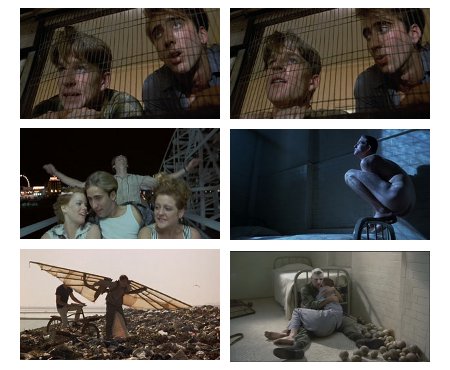
The movement of the camera is an invitation to dream, to freedom and to a certain overview of the social difficulties expressed by this tracking shot over the districts of Philadelphia.
Despite the film’s heavy subject matter, it never falls into excessive pathos. Small touches of humor bring a certain lightness to a film that serves as a portrait of a society.
The original soundtrack by Peter Gabriel adds emotional depth. At first listen, the music seemed somewhat dated due to the 80s synthesizers. However, upon revisiting it, I realized that the OST perfectly aligns with the film’s atmosphere, oscillating between soaring melodies and deep melancholy.
Peter Gabriel – Quiet And Alone
Peter Gabriel – Birdy’s Flight (From Not One Of Us)
Peter Gabriel – Sketchpad With Trumpet And Voice
Beyond its narrative, Birdy raises a crucial question: how can we prevent a soldier’s trauma? The Vietnam War, whose objectives were poorly understood by the American public, left countless veterans shattered, confronted with the absurdity of a senseless conflict.
In response to this risk, modern societies seek to construct a new collective imagination around the concepts of “moral strength” and “strength of soul“ for nations. But this ideal, intended to promote resilience and unity, gradually turns into a societal injunction, marginalizing those who, like Birdy, refuse to conform—the dreamers, the rebels, the misunderstood.
(updated post from 28 jully 2011)
Leave a Reply