Movies about the father-son bond have always resonated deeply with me. They usually end up among the top films in my collection. The Story of Jim (2024) by Arnaud and Jean-Marie Larrieu is no exception and joins the ranks of the Japanese film Like Father, Like Son (2013) by Hirokazu Kore-eda and Paris, Texas (1984) by Wim Wenders.
I discovered The Story of Jim (2024) after hearing about Karim Leklou’s César win for Best Actor in 2025. He was up against Pierre Niney, the favorite for his mastery of dramatic roles, his expressive brilliance, and his ability to physically transform himself. This kind of performance is typically more successful in Hollywood, “where people appreciate the visible effort of an actor to become someone else, real or fictional,” as Henri Quantin insightfully puts it. The critic adds that this celebration of kindness also reveals its limits—when it becomes a way to avoid conflict, to never take a stand, and ultimately, to let others or circumstances make decisions in one’s place.
A rather harsh take, considering the film portrays Aymeric (played by Karim Leklou) as a man who meets Florence, a former colleague who is six months pregnant. He invests himself in their relationship and raises Jim as his own son. In fact, he chooses not to have children of his own out of respect for Jim. But when Jim’s biological father reappears, Aymeric’s fatherhood—built on his acceptance of Florence’s somewhat unconventional choices and his lack of precautions—is put to the test.
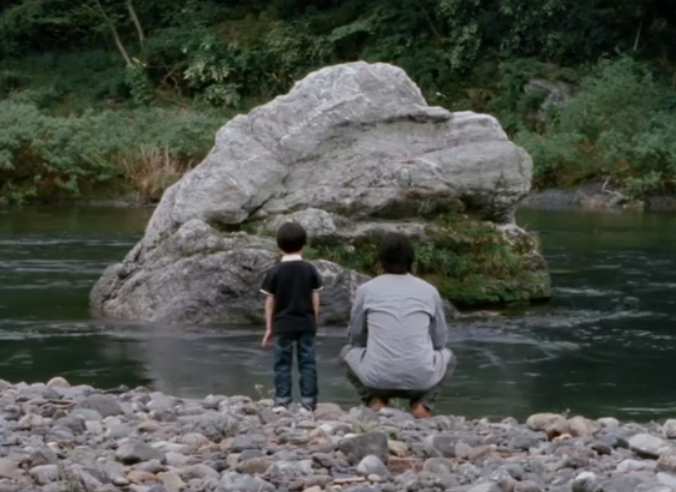
Aymeric is a kind father—unlike Ryota, the ambitious and distant father in Like Father, Like Son. In Kore-eda’s film, Ryota discovers that due to a nurse’s mistake, his biological son was raised in a modest but warm family, while the boy he raised for six years is not his “blood” son. He faces a dilemma: should he restore what he sees as the natural order, or accept that human relationships, even familial ones, are socially constructed?
We move in an entirely different direction with Paris, Texas—a film about a silent, lost man who reappears after years of absence. Through the vast desert landscapes of Texas and the streets of Houston, the film tells the story of his attempt to rebuild his past, reconnect with his son, and mend a broken love story. The biological father, Travis, reunites with his son despite the fact that he had been raised for years by his uncle and aunt, who were unable to have children.
Paris, Texas remains my favorite film. Probably because its depth goes beyond just a father-son relationship. It explores the destructive consequences of passionate love and the desperate attempts to repair it. The film’s aesthetics play a major role as well, carried by a magical acoustic guitar score that accompanies this American road movie. The complex atmosphere shifts between contemplative beauty, lighthearted moments with humorous touches, and deeper, more intimate scenes filled with subtle undertones. A well-deserved Palme d’Or at Cannes.
I could have mentioned The Son (2002) by the Dardenne brothers. But I’ve already said quite a lot, and its storyline would require further digressions. Maybe another evening.
Leave a Reply